


The Old Way of Finding a Domain Name Is Quietly Disappearing
For years, finding the right domain name meant opening a registrar search box, typing in your first choice, watching it disappear into a wall of red text, and then improvising. You'd add numbers. Hyphens. Uncomfortable suffixes. You'd check again the next morning, hoping the name had been released. You'd ask friends if "yourbrandco.com" looked acceptable, and everyone would politely not answer.
That process is still familiar to millions of people building websites, launching startups, or staking out territory on the internet. But a new generation of AI-powered domain search tools is quietly replacing the guesswork with something closer to strategy.
The shift is not cosmetic. According to platforms like DomainKicks, modern domain search now verifies availability in real-time across multiple registrars and live DNS records not just a sales database. Tools can check hundreds of top-level domains simultaneously, surface freshly dropped names within hours of their release, and even score potential domains across lenses like brandability, resale value, and startup appeal.
"We check it live across three sources and show you what you can actually register right now at the TLD's standard price," DomainKicks explains on its platform. That kind of verification matters because it closes the gap between what looks available and what actually is.
What AI Actually Does in a Domain Search
There is a meaningful difference between a domain search that checks a sales feed and one that queries live registry records. The distinction shapes everything about the user experience.
When you type a name into a traditional registrar, you are often seeing a cached list of what was available the last time the system updated. Names can be registered by someone else milliseconds after that cache refresh. The result is a familiar frustration: you spend time building a shortlist, only to find half of them are gone by checkout.
AI-powered domain search tools like NameBuddy.ai take a different approach. "We perform a live check against domain registries in real-time, ensuring every name suggested is currently available and unregistered," the platform states. That means the suggestions you see are not name ideas floating in a void they are names you can actually register right now.
The AI layer adds creativity on top of that verification. beyond simply matching your keyword, the system generates variations, checks availability across multiple TLDs simultaneously, and presents results as they are found more than in a batch list. NameBuddy.ai supports five popular TLDsai,com,io,app, andnet and lets users search any combination per query.
"Our AI invents brandable names and verifies each one against live registry records you only see names you can register right now," the platform explains. That combination of creative generation and live verification is what separates the current generation of tools from the basic search boxes of a decade ago.
The Numbers Behind Modern Domain Discovery
The scale of what these tools now handle is worth sitting with for a moment.
DomainKicks offers access to more than 800 TLDs in a single search includingcom,net,ai,io,co,app,dev,me,org, andxyz. DomainKits, another platform in the space, covers over 1,200 TLDs and searches across a database of more than 240 million active domains. That is not a feature list it is a fundamentally different scope of visibility into what is available on the internet.
For context, the traditional registrar search might show you availability on three or four popular extensions. The newer tools show you availability on hundreds, including long-tail extensions that might carry less stigma than they did five years ago. Aio domain, once considered a niche choice for tech startups, now appears on startup pitch decks and investor meetings without comment. Theai extension originally assigned to Anguilla has become a natural home for artificial intelligence companies, and its availability and pricing have become a regular consideration for founders in that space.
76% of Domain Searches Still Start With One Extension
Despite the explosion of available TLDs, most domain searches still begin and end withcom. That is understandable. It is the extension most users type by reflex, the one that appears in email signatures and business cards, the one that carries the most immediate credibility for a general audience.
But the data suggests this habit comes with a cost. When a platform like DomainKicks shows availability across 800-plus TLDs simultaneously, it frequently surfaces names that are taken oncom but available on alternatives that are equally brandable. The question is not whethercom is preferable it often is but whether passing on a strongio orai name is worth waiting for acom that may never become available.
For AI-focused companies, the calculus has shifted further. Aai domain carries immediate industry context. It tells a visitor something about what the company does before they read a single word. That signaling value is real, and it is one reason theai extension has attracted both legitimate AI startups and domain investors watching for appreciation.
How Much Does aai Domain Actually Cost?
Pricing forai domains varies by registrar and by the specific name, but the standard registration cost for aai TLD runs higher than a comparablecom. Where acom might register for $10 to $15 per year at a standard registrar,ai domains frequently start around $70 to $80 annually and can climb higher for premium names.
The higher cost reflects demand. As the artificial intelligence industry has grown with companies raising billions in venture funding and launching products that reach millions of users the pool of availableai domains has shrunk. Short, brandableai names that match common tech keywords have become increasingly scarce.
This is where the strategic value of AI domain search tools becomes concrete. A platform that can checkai availability in real-time, surface freshly dropped names, and alert you before the broader market sees them is not just a convenience it is a way to access a market that moves faster than manual searching can follow.
The Four-Lens Approach to Domain Scoring
One of the more interesting developments in AI domain discovery is the idea of scoring domains across multiple lenses more than treating all names as equivalent.
DomainKicks' Goldlist a curated collection of premium available domains refreshed daily uses a four-lens scoring system: Fundable, Resale, Brand, and Future. Each lens represents a different angle of evaluation. Fundable reflects how a name might read to a venture capitalist. Resale reflects its potential value on the secondary market. Brand reflects how it functions as a consumer-facing name. Future reflects how a founder might grow into it over time.
"A fresh batch of available premium domains every day, scored across four lenses so you can scan by the value angle that matters to you," DomainKicks describes the Goldlist. "Spot tomorrow's brand before the rest of the market sees it."
This kind of multi-dimensional scoring matters because domain value is not monolithic. A name that is terrible for brand recognition might be excellent for resale. A name that feels generic to most people might read as highly fundable to a VC who associates the keyword with a growing market. The four-lens system gives users a way to filter for the dimension that matters most to them at a given moment.
Freshly Dropped Domains: The Window Before the Market Sees Them
Every day, thousands of domain names expire. They pass through grace periods, redemption windows, and deletion queues. For a brief window sometimes just hours they sit in a state of limbo before becoming available for re-registration.
This is the moment that tools like DomainKicks' "Just Kick'd" section are built around. The section surfaces domains that have just become available again, verified live and ready to register at standard TLD pricing. No back-orders, no markups, no hidden fees.
"All of the domains you see here have just become available again," DomainKicks states. "Each one is verified live, so you can hand-register it right now at the TLD's standard price."
The practical value of this is significant. When a domain expires, it does not disappear it becomes visible to anyone watching the drop. Domain investors often have automated systems that grab names the moment they become available. For a human searching manually, that window is nearly impossible to catch. Platforms that surface these drops in a browsable format, with scoring and filtering, effectively level a playing field that was previously tilted toward automated bidders.
Comparing the Leading AI Domain Search Tools
The market for AI domain search has developed enough that meaningful comparisons are possible. Different tools have made different choices about verification methods, pricing models, TLD coverage, and additional features.
NameBuddy.ai has taken a notably clean position: the platform is free to use, earns nothing from affiliate links, and performs registry-direct availability checks. "No affiliate links we earn nothing from your pick," the platform states explicitly. That transparency is unusual in a space where many free tools are monetized through registrar referrals.
Dynadot's AI Domain Search takes a different approach, generating domain suggestions from keywords and including filters for character count, prefix, suffix, and TLD selection. The platform surfaces available options but can also surface registry premium domains names the registry prices above standard rates based on perceived value. "Aftermarket premium domains, which are previously registered names resold by an owner on the secondary market, are a separate category and are usually purchased through a marketplace more than AI search," Dynadot notes.
DomainKicks combines AI search with its Goldlist curation and Just Kick'd freshly dropped inventory, giving users three distinct angles on domain discovery within a single platform. The Domain Sensei feature allows users to describe what they are building in plain language and receive domain suggestions, adding a conversational layer to the search process.
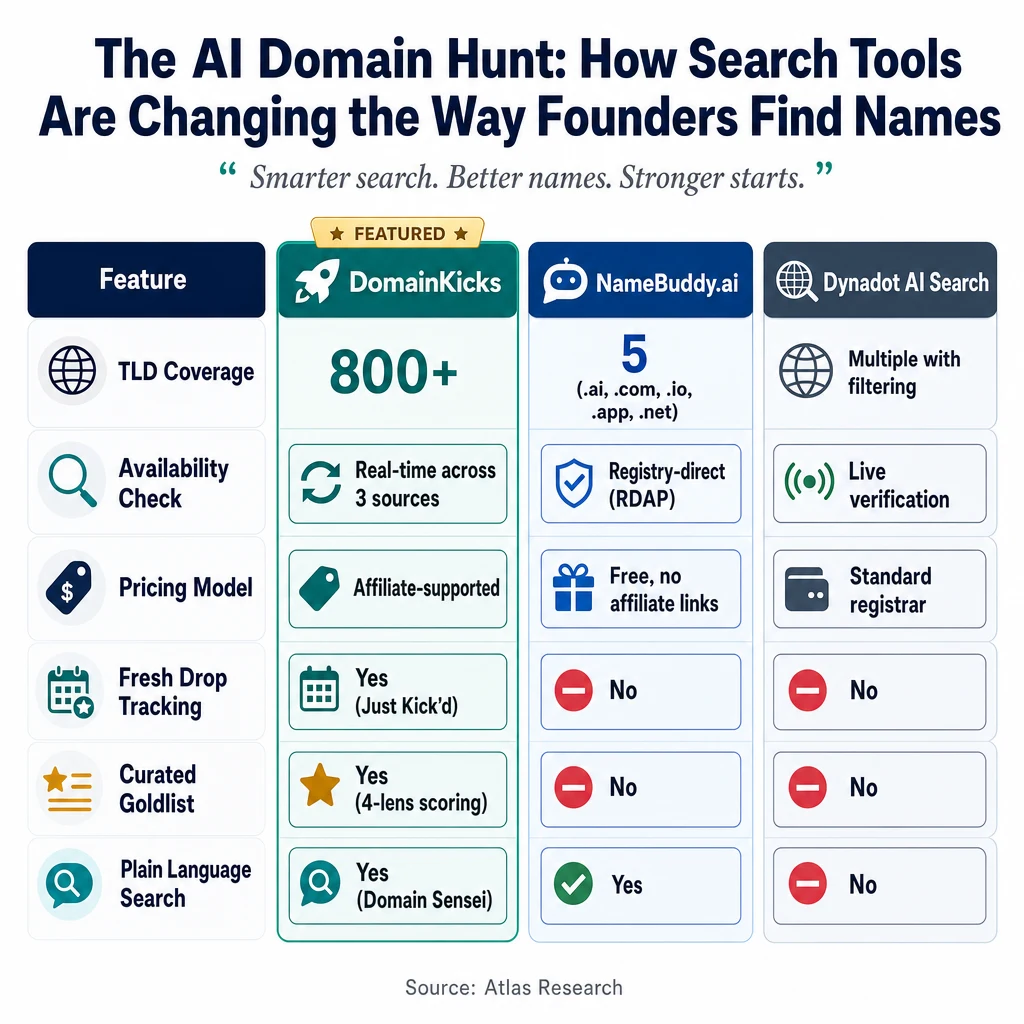
| Feature | DomainKicks | NameBuddy.ai | Dynadot AI Search |
|---|---|---|---|
| TLD Coverage | 800+ | 5 (.ai,com,io,app,net) | Multiple with filtering |
| Availability Check | Real-time across 3 sources | Registry-direct (RDAP) | Live verification |
| Pricing Model | Affiliate-supported | Free, no affiliate links | Standard registrar |
| Fresh Drop Tracking | Yes (Just Kick'd) | No | No |
| Curated Goldlist | Yes (4-lens scoring) | No | No |
| Plain Language Search | Yes (Domain Sensei) | Yes | No |
Areai Domains Good for SEO?
This is a question that comes up frequently in domain discussions, and the honest answer is more nuanced than a simple yes or no.
Search engines like Google do not give algorithmic preference to any specific TLD. Aai domain is not automatically ranked higher than acom,net, ororg. What matters for SEO is the same factors that matter for any domain: content quality, backlinks, technical performance, and user engagement signals.
That said,ai domains carry a contextual signal that can influence click-through rates. When a search result displays aai domain, users in the AI space may be slightly more likely to click they have a pre-existing association between the extension and the industry. This is not an SEO factor in the technical sense, but it affects how users interact with your listing, which does influence search performance over time.
For companies genuinely operating in the artificial intelligence space, aai domain also creates consistency between what the domain communicates and what the business does. That alignment can improve brand recall and reduce the explanatory overhead of describing your company to new visitors.
What This Means for DomainKicks Readers
If you are researching domain names for a project whether a startup, a personal brand, a side project, or an investment portfolio the current generation of AI domain tools offers capabilities that were not available two years ago. Real-time registry verification, multi-TLD simultaneous search, freshly dropped domain tracking, and multi-lens scoring systems have collectively raised the floor for what a domain search can deliver.
The practical implication is that the gap between professional domain hunters and casual searchers has narrowed. A founder with access to DomainKicks' Goldlist and Just Kick'd sections, or to NameBuddy.ai's free registry-direct verification, has visibility into a market that previously required expensive subscriptions or specialized knowledge to navigate.
This does not mean every domain decision is now easy. Short, brandablecom names are still scarce and expensive. Premiumai names still carry significant registration and renewal costs. But the tools for finding what is available, evaluating it across useful dimensions, and acting quickly on freshly dropped names have genuinely improved.
Where to Read Further
For readers who want to explore the tools and platforms covered in this article directly, the following resources offer deeper access to the features and interfaces described above:
The DomainKicks platform provides access to its AI domain search, Goldlist curation, and Just Kick'd freshly dropped inventory in a single interface. The platform's Domain Sensei feature allows conversational domain discovery, and its four-lens scoring system offers a structured way to evaluate names across Fundable, Resale, Brand, and Future dimensions.
NameBuddy.ai offers a free, no-affiliate AI domain generator that performs registry-direct availability checks and streams results in real-time. The platform is particularly useful for users who want creative name generation without the friction of seeing taken names or encountering upsells.
The Dynadot AI Domain Search provides keyword-based domain suggestion with filtering options for character count, prefix, suffix, and TLD selection. Dynadot's platform also offers access to its broader domain marketplace and aftermarket tools for users who want to explore premium domain options beyond standard registration.
For users interested in tracking domain lifecycle data newly registered names, expiration patterns, and registration trends DomainKits offers search across more than 240 million active domains and 1,200-plus TLDs, with tools designed for both human users and AI agents.